
Why Your Brand Identity Should Drive Your Interior Design Decisions


Most businesses approach brand identity and interior design as two separate projects. They engage a branding agency first — or sometimes last — and hire an interior designer independently. Both parties do competent work. The brand guidelines look polished. The space looks impressive.
But the two rarely feel like the same business.
There is a specific quality to spaces that have been designed from a brand-first foundation. Clients recognize it immediately, even if they cannot articulate why. The proportions feel intentional. The material palette matches the company's tone. The way the space makes you feel corresponds precisely to how the brand has been positioned.
This coherence is not accidental. It is the result of a design process that treats brand identity not as a decorative reference — something to match the logo color to the accent wall — but as the strategic foundation from which every interior decision is made.
For businesses operating in Riyadh's competitive commercial landscape, this distinction has direct consequences for client perception, conversion, and retention. Understanding it is the first step toward building a space that actually works.
What Brand Identity Really Means in a Physical Space
Brand identity, in its conventional definition, governs how a company looks and communicates across digital and print touchpoints — logo, color palette, typography, tone of voice. Most brand guidelines stop there.
But a brand identity is more accurately defined as the sum of every impression a client or customer receives from your business. That includes your website, your proposals, and your team's communication style — and it absolutely includes your physical environment.
When a client walks into your office, showroom, restaurant, or retail space, they are forming a brand judgment. Within the first moments of arrival, before a word has been exchanged, they are assessing whether your business is worth trusting at the level you are asking them to trust it.
A space that contradicts your brand positioning — that feels generic when your brand promises distinction, or overwhelming when your brand promises refinement — creates immediate cognitive dissonance. Clients may not identify the cause, but they feel the effect. It introduces doubt at precisely the moment you need confidence.
A space that confirms and extends your brand positioning does the opposite. It validates the client's decision to engage with you before you have said anything.
The Cost of Designing Brand and Interiors Separately
Disconnected Decision-Making
When a branding agency and an interior designer work independently, each party optimizes for their own brief. The branding agency delivers guidelines for digital and print. The interior designer interprets those guidelines through the lens of spatial aesthetics, budget availability, and material trends.
The result is almost always a translation gap. Colors are approximated rather than calibrated. The brand's psychological positioning — its intended emotional register — rarely survives the handoff into material and spatial decisions. What arrives on site is a space that references the brand visually but does not embody it.
Extended Timelines and Redundant Revisions
Separate briefs mean separate revision cycles. When the interior design is completed and the brand team reviews it, misalignments are identified late — often after procurement, sometimes after installation. Corrections at that stage are expensive and disruptive.
The pattern is common enough that most businesses accept it as normal. It is not. It is a structural consequence of treating two deeply connected disciplines as independent workstreams.
A Space That Loses Relevance Quickly
Spaces designed without brand intelligence tend to follow the aesthetic trends current at the time of their design. They look dated within three to five years — not because the materials have degraded, but because the space was anchored to a trend rather than to a brand identity with longevity built in.
A brand-driven space, by contrast, is designed around the core of what the business is and intends to remain. It ages as a brand ages — with authority rather than obsolescence.
What Brand-Integrated Interior Design Actually Looks Like
It Begins Before a Single Material Is Selected
Brand-integrated interior design starts with the brand strategy, not with the floor plan. Before any spatial decisions are made, the following questions must be answered with precision:
What emotional state should clients be in when they arrive, and when they leave?
What does this brand's positioning communicate about quality, restraint, boldness, or warmth — and how should the spatial environment reinforce that?
Where in the client journey does this space sit? Is it a first impression, a working environment, or a closing room?
What sensory experience — not just visual, but acoustic, tactile, and olfactory — should the space produce?
The answers to these questions become design constraints as precise as any structural limitation. They govern material selection, spatial proportion, lighting strategy, and threshold design.
Color Is the Starting Point, Not the Whole Brief
Brand color application in interior design is frequently misunderstood. It does not mean painting a wall in the logo's primary color or upholstering furniture in brand shades. That approach produces spaces that feel like marketing materials rather than environments — forceful and uncomfortable to inhabit over time.
Brand color in a spatial context means understanding the psychological register of the color palette and building a material palette that operates in that register across the full spectrum of light conditions the space will experience. A brand whose palette communicates warmth and approachability requires a completely different material temperature than a brand whose palette communicates precision and technical authority — even if both palettes share similar hue families.
This calibration requires someone who understands brand strategy and spatial design simultaneously. It cannot be reliably achieved through a handoff between two separate specialists.
Typography and Proportion Have Spatial Equivalents
Every brand guideline specifies typography — the visual rhythm, weight, and spacing that governs how the brand communicates on the page. Spatial design has direct equivalents.
The visual weight of brand typography corresponds to the material weight of a space — whether it feels light and refined or solid and authoritative. The spacing rules that govern brand layouts correspond to the spatial rhythm of a floor plan — how tight or generous the intervals between architectural elements feel. The hierarchy of a brand's typographic system corresponds to the hierarchy of a spatial sequence — which volumes announce themselves and which recede.
A designer working from brand guidelines alone will see instructions for a PDF. A designer who understands brand intelligence will see a blueprint for an environment.
The Ironwood Approach: Brand First, Space Second
At Ironwood Solutions, every commercial project begins with a brand intelligence session — a structured review of the client's existing brand positioning, guidelines, and strategic objectives. If brand guidelines do not yet exist, we develop them as the first phase of the project.
This is not a formality. It is the foundation from which every subsequent design decision is made.
Once the brand intelligence is established, it informs the sensory brief — defining the emotional and behavioral outcomes the space must produce across all five senses. The spatial design follows from that brief, with material selection, lighting strategy, spatial proportion, and threshold design all governed by a single, coherent set of brand-driven parameters.
The result is a space that does not reference the brand. It embodies it.
For clients who have experienced the conventional model — brand agency, then interior designer, then contractor, then corrections — the difference in process and outcome is significant. Decisions are made faster because the brief is unified. Revisions are fewer because all parties are working from the same strategic foundation. The final environment has a coherence that no amount of post-production adjustment can replicate.
This is what we mean by integrated design. And it is why, for commercial clients in Riyadh and across the region, it represents a fundamentally better use of design investment.
Residential Application: Home Branding
Brand-driven design is not exclusive to commercial projects. For residential clients who understand that their home is an expression of personal identity — not simply a collection of aesthetic preferences — the same principle applies.
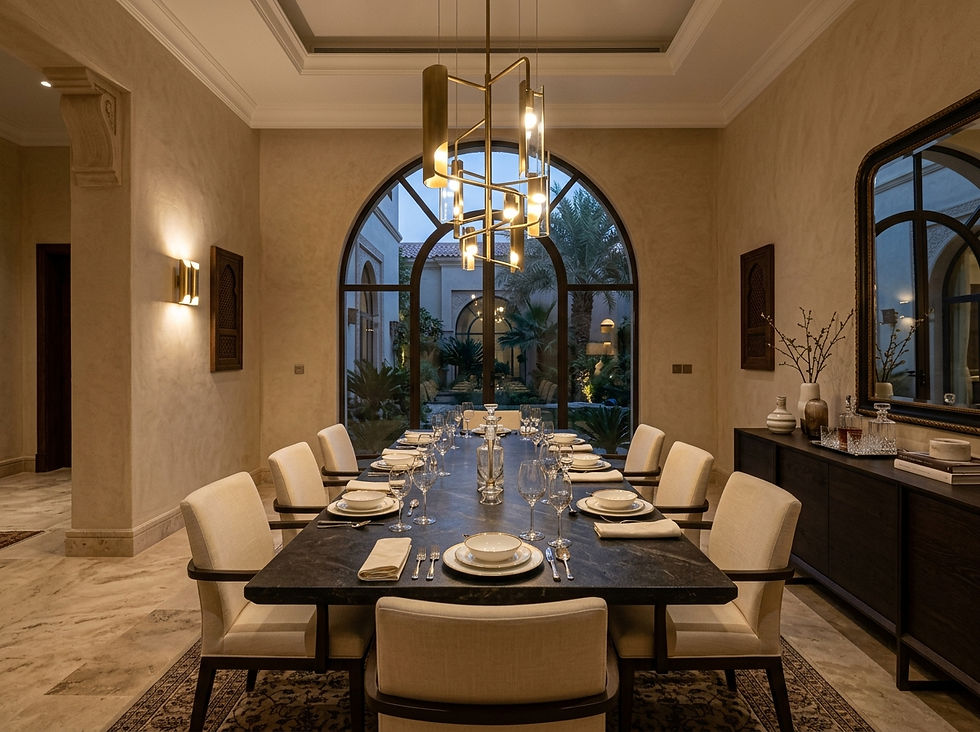
A home designed around a clear, considered personal identity brief has a coherence that generic luxury cannot produce. It feels inhabited by a specific sensibility rather than assembled from a catalog. Materials, proportions, and sensory details align because they were selected against a unified brief, not sourced from separate inspiration boards.
At Ironwood, we refer to this as home branding — the application of brand intelligence methodology to residential design. It is one of the distinguishing features of our residential practice, and it is the reason our projects feel distinctly personal rather than generically elevated.
Starting With the Right Question
The question most businesses ask at the start of an interior design project is: what should this space look like?
The question that produces better results is: what should this space do?
What impression should it create on arrival? What behavior should it encourage? What should clients feel when they leave — and what should they remember? These are brand strategy questions. They happen to have spatial answers.
If you are planning a commercial or residential project in Riyadh and want to understand what a brand-integrated approach would mean for your specific brief, Ironwood Solutions offers an initial consultation structured around exactly these questions.
The starting point is your brand. The result is a space that cannot be mistaken for anyone else's.
Related reading: What Is Sensory Design? A Guide for Luxury Homeowners and Businesses | The Hidden Cost of Separating Your Branding Agency from Your Interior Designer (coming soon)


Comments