
Saudi Cultural Identity in Contemporary Interior Design


Saudi homeowners planning luxury interiors typically want spaces that meet the standard of the best hotels and residences they have experienced in Dubai, London, or Milan. That is a reasonable aspiration. The rarer aspiration — and the one that produces genuinely distinctive work — is the homeowner who wants something that could only be this specific home, in this specific city, belonging to this specific family. International calibre in its execution. Saudi at its core.
The Problem With Imported Aesthetics
Contemporary minimalism, Mediterranean warmth, French classicism — these are coherent visual languages that work in their original contexts because they are expressions of the cultures, climates, and material traditions that produced them. Applied to a Riyadh villa, they produce competent, sometimes beautiful environments that feel like versions of somewhere else. The stone is Italian. The palette is European. Nothing locates the space in Saudi Arabia specifically.
The result is an aesthetic homogeneity at the upper end of Riyadh's residential market: the same references, the same absence of cultural grounding, the same missed opportunity. Not because designers or homeowners are making a poor choice — but because the extraordinary design heritage that exists here is systematically undervalued relative to imported styles.
What Saudi Design Heritage Actually Offers
Three things, specifically.
Geometric vocabulary. Islamic geometric design — developed across more than 1,000 years of mathematical and aesthetic refinement — is one of the most technically sophisticated decorative systems in the history of design. Its patterns are not ornament: each is derived from precise geometric construction, expressing mathematical principles in visual form. Applied in plasterwork, carved timber, ceramic tile, or handwoven textile, this vocabulary produces environments of genuine intellectual depth alongside their visual richness.
Material palette. The materials of the Arabian peninsula — sandstone, gypsum plaster, date palm timber, raw clay — have a warmth and groundedness that imported marble and polished concrete consistently fail to match. Not because they are better materials in an absolute sense, but because they belong to this landscape. Their presence in an interior creates an immediate sense of place that premium imported stone cannot replicate regardless of cost.
Spatial logic. The Saudi organisation of domestic space — the generosity of reception areas, the hierarchy between public and private zones, the deliberate use of threshold and transition to manage movement — is a design system refined over many generations of living in this specific social and physical environment. It is not decorative; it is functional intelligence about how Saudi households actually live.
Engaging Heritage Without Producing Pastiche
The risk is copying motifs rather than applying principles. A contemporary interior with geometric stenciling on the walls and a mashrabiya panel in the entrance is not a Saudi interior — it is a contemporary interior wearing a traditional costume.
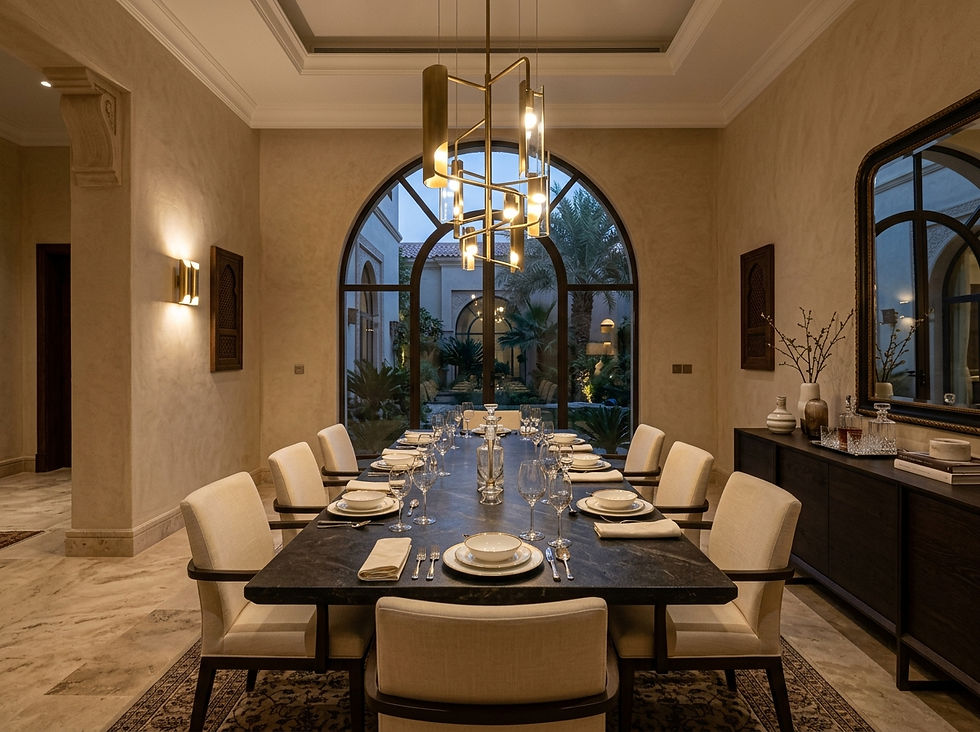
The distinction: heritage as structure versus heritage as decoration. A well-executed contemporary Saudi interior may contain nothing that reads as explicitly "traditional." What it will have is earthen warmth in its material palette, geometric resolution in its architectural details, and spatial generosity in its reception zones — the underlying logic that makes a space feel Saudi rather than just expensive.
Work at the level of principle. Earthen warmth in material selection. Geometric proportion as the basis for spatial organisation. Perimeter logic in gathering spaces. These are principles. Applying geometric stencils to walls is costume.
Ironwood Solutions and Saudi Design Identity
At Ironwood Solutions — co-founded in Riyadh in 2016 — Saudi cultural identity is not a brief option. It is the starting assumption. The firm was built on the conviction that the best design for Saudi clients is design that knows where it is from: world-class in execution, grounded in the aesthetic heritage, spatial values, and material culture of the Arabian peninsula.
For homeowners in Saudi Arabia who want a home that is genuinely theirs — rooted in their own culture, executed to the highest international standard — the consultation is where that work begins.
Frequently Asked Questions
Why do international design styles feel out of place in Saudi homes even when executed well? Because they were developed for different climates, cultures, and social structures. Mediterranean warmth works in Mediterranean light. French classicism works with French spatial norms. When applied to a Riyadh villa, these styles produce technically competent work that is culturally unmoored — spaces that look like somewhere else rather than somewhere specific. That disconnect is felt even when it cannot be articulated.
What is the difference between Saudi cultural design and Najdi design specifically? Najdi design is one regional tradition within a broader Saudi design heritage. It is the dominant vernacular of the central plateau — shaped by the Nejd's specific climate, materials, and cultural practices. Saudi design heritage also includes Hijazi traditions (more influenced by the trade routes of the western coast), Asiri design (distinguished by its painted decoration), and the broader tradition of Islamic geometric design shared across the peninsula. Ironwood Solutions draws on this full breadth rather than treating Najdi as synonymous with Saudi.
How do I know if an interior is drawing on Saudi heritage authentically or using it as decoration? The test is whether the heritage is functioning as structure or as surface. Authentic engagement produces spatial logic, material warmth, and geometric resolution that feels integral to the design — the kind of groundedness that no imported style produces. Decorative application produces a contemporary interior with traditional objects placed within it. The former feels Saudi; the latter feels like a Saudi-themed international interior.

Comments