
Everything You Need to Know About Majlis Design


Before a word is spoken, the majlis tells a guest what kind of household this is. It is the room where business gets discussed and relationships form, where the family's understanding of hospitality becomes physical. No other room in the Saudi home carries more communicative weight. Getting its design right is not a matter of style — it is a matter of understanding what the room is for.
What the Majlis Actually Is
The word comes from the Arabic root meaning "to sit." The room that bears the name is, at its core, a space designed for intentional sitting together — not passive or casual, but the structured face-to-face conversation that is the foundation of Saudi social life.
The spatial logic of the traditional majlis reflects this function directly: seating arranged along three or four walls, the entrance on the remaining side, the centre of the room open. Everyone present is visible to everyone else. No position is architecturally isolated. The room communicates equality of presence, while the host's seat introduces a subtle order within that equality. It is a room designed for encounter.
In a contemporary Saudi villa, the majlis may serve formal guest reception, family gathering, business meetings, or all three. A well-designed majlis accounts for this full range rather than optimising for one use at the expense of others.
The Spatial Logic and Why Departing From It Costs
A majlis designed around a central sofa grouping — in the manner of a Western drawing room — loses the perimeter logic that defines the traditional arrangement. The social dynamic changes. The sense that everyone is present to everyone else dissolves into a configuration where some people face the room and others face the wall.
The spatial principle worth preserving is not the exact traditional form but the arrangement it produces: perimeter seating that makes the whole room a shared field of attention. Contemporary adaptations that honour this principle while adapting proportions and materials to the contemporary interior produce rooms that feel Saudi rather than merely expensive.
The size of the majlis relative to the rest of the villa is also a spatial statement. Traditional Saudi homes allocated proportionally more floor area to the majlis than to any other room — because the value placed on hospitality was expressed in the physical generosity of the space dedicated to it. A majlis compressed to below 40 square metres in a large villa is making a statement the homeowner should be deliberate about making.
Acoustic Requirements
A majlis exists to facilitate conversation — extended, substantive, face-to-face, in groups of ten to twenty people. Its acoustic requirements differ from most rooms in the house.
In a reverberant room — large, hard-floored, minimal soft furnishing — the simultaneous conversations of a full majlis create background noise that makes individual conversations effortful. The traditional solution is also the acoustically correct one: heavily upholstered perimeter seating, layered textiles, rugs, and soft furnishings distributed around the room's edges. Each of these materials absorbs reflected sound and reduces reverberation time. Together they create the acoustic intimacy that makes extended group conversation comfortable rather than fatiguing.
Contemporary designs that favour polished stone floors and minimal soft furnishing in the majlis sacrifice this quality. The room looks impressive in photographs. In use, it becomes acoustically exhausting after forty minutes.
Lighting
Majlis lighting should be warm, layered, and independently dimmable. The room functions across a range of times and social conditions — formal afternoon receptions, late-evening family gatherings — and the lighting must shift between these modes without the room feeling either overlit or gloomy.
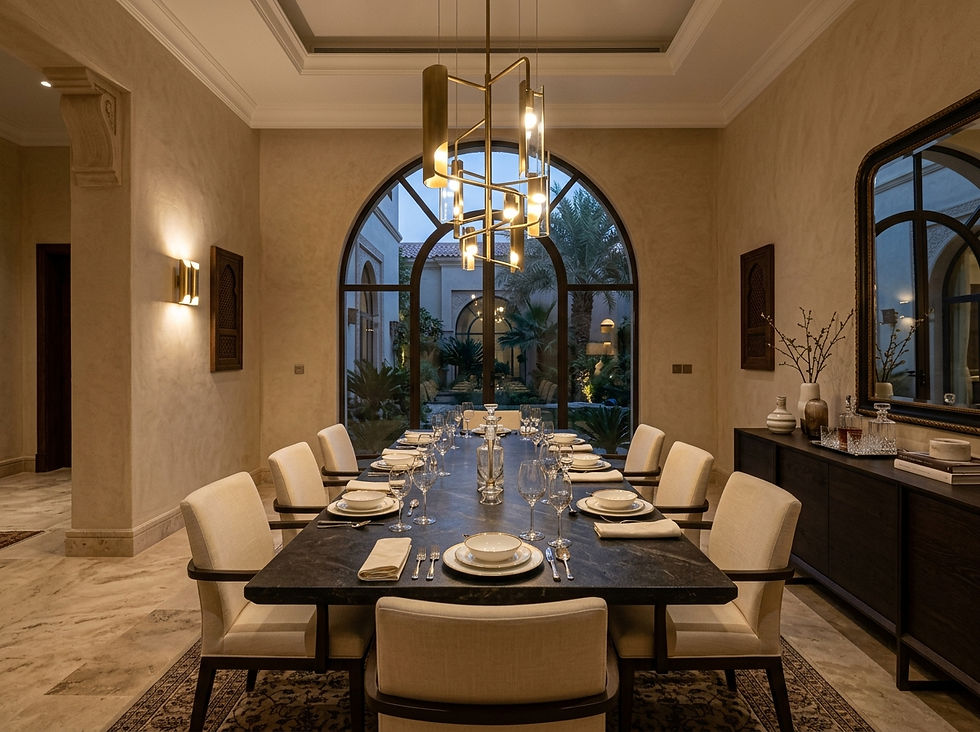
Three layers: a low-level recessed ambient source that can be dimmed to near-nothing; wall-mounted sconces at seating height that create warmth at the level where faces and conversations happen; and a central feature light — pendant, chandelier, or lantern — that anchors the room visually without dominating it functionally. All three independently controlled. The ability to raise the wall sconces while reducing the ambient overhead is what gives a majlis its range of atmospheric conditions.
Materials and the Statement of Welcome
The materials of the majlis communicate the family's standards to every guest who enters. They are the most publicly evaluated surfaces in the home.
Natural stone floors in honey travertine or warm limestone, textured hand-applied plaster walls, handwoven textiles in deep jewel tones, carved timber or hammered metalwork in the details — these produce an environment of genuine material quality. The difference between natural stone and ceramic that mimics it, between hand-woven fabric and its machine equivalent, is not visible in a photograph but immediately apparent to anyone who has spent time around the real thing. The majlis is exactly the room where that difference matters most.
Ironwood Solutions and Majlis Design
At Ironwood Solutions — a Riyadh luxury design firm in operation since 2016 — the majlis receives more design attention than any other room in a Saudi residential project. Every majlis design begins from a clear understanding of how this specific household uses and values this specific room: the nature of the hospitality it extends, the guests it receives, and the statement it makes about the family that inhabits the home.
For homeowners in Riyadh designing or redesigning a majlis, the consultation is where that understanding begins.
Frequently Asked Questions
What is the ideal size for a majlis in a luxury Saudi villa? The traditional principle is that the majlis should be proportionally generous relative to the rest of the house — the primary expression of the value placed on hospitality. In practical terms, a majlis that comfortably seats 16–20 guests in perimeter arrangement typically requires a minimum of 45–55 square metres. Smaller than this in a large villa sends an unintended message about priorities.
How do you prevent a majlis with a hard stone floor from becoming acoustically uncomfortable? Perimeter upholstered seating, layered rugs of substantial weight, lined curtains, and textured wall surfaces. Each absorbs reflected sound from a different surface. Together they reduce reverberation time to a range where extended group conversation is comfortable. The room does not need to be soft throughout — the perimeter treatment does the acoustic work.
Does a contemporary majlis have to follow the traditional three-wall seating arrangement? Not in exact form. But departing significantly from the perimeter logic changes the room's social dynamic. The principle worth preserving is the arrangement that makes everyone present to everyone else — the specific form can adapt to contemporary proportions and materials while maintaining that quality.

Comments