
The Majlis Reimagined: Designing a Modern Saudi Gathering Space


Two pressures pull at every contemporary majlis design. The first is cultural: the room's social logic — perimeter seating, collective visibility, the spatial communication of welcome — has defined Saudi hospitality for centuries and does not become optional when the furniture changes. The second is aesthetic: Saudi homeowners in 2025 have experienced world-class hospitality design and expect their homes to hold that standard. Neither pressure goes away. The best contemporary majlis designs resolve both.
The answer is not to replicate the traditional form literally. Nor is it to borrow a Western drawing-room configuration and call it a majlis. It is to be precise about which elements are structural — the things that make a majlis a majlis — and which are expressive, free to be reinterpreted in any aesthetic language that serves the room's function.
What Cannot Change: The Social Logic
The perimeter seating arrangement is non-negotiable. Not the exact traditional form — not the floor cushions, the carved timber, the heavy brocade. The spatial logic: seating around the room's edges that puts every person present in visual contact with every other person, with the centre open. This is what the majlis is for. A room with beautiful contemporary finishes but a central furniture arrangement borrowed from a Western living room is not a well-designed contemporary majlis. It is a well-finished room that fails its primary purpose.
Contemporary seating profiles — typically 30–40 cm seat height versus traditional floor cushions at 10–20 cm — read as modern while preserving the low-level visual plane and the sense of ease and proximity that the traditional form creates. The geometry changes. The social logic does not.
What Can Evolve: Material and Aesthetic Expression
Everything else is open. Material palette, lighting approach, decorative vocabulary — these are expressions of the room's cultural identity, not the identity itself.
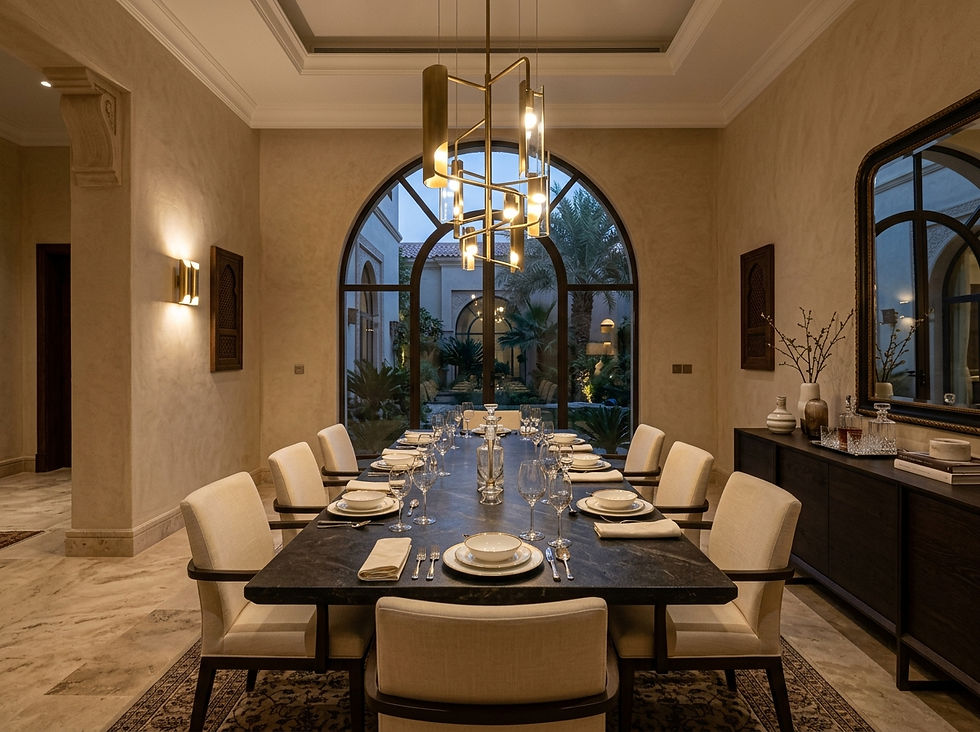
A contemporary majlis can express warmth through travertine and hand-applied plaster rather than carved timber. It can carry geometric pattern in a coffered ceiling or a hand-knotted rug rather than in heavy textile upholstery. It can use recessed ambient light supplemented by wall-mounted sconces at seating height rather than a traditional chandelier. None of these are departures from the majlis. They are the same cultural logic in a different material language.
The test for every aesthetic decision: does it serve the room's function or work against it? Hard, highly polished surfaces that look striking in photographs become acoustically fatiguing within 40 minutes of a full gathering — exactly the condition a majlis is built to host. Minimal seating that prioritises visual lightness over physical comfort serves the photographer, not the guest. The contemporary majlis that performs well is the one where no aesthetic choice has been made at the room's expense.
The Transition and Arrival Experience
What Ironwood Solutions refers to as the threshold moment — the transition from the villa's main arrival into the majlis — is part of the room's design even when it falls outside the room itself. A considered entrance corridor, a door of appropriate scale and material weight, a deliberate compression and release before the room opens: these communicate the quality of the welcome before the guest has seen anything.
A minimum approach of 3–4 metres between the villa's main entry and the majlis door is enough to create this effect. Less than that and the guest is inside the room before there has been any spatial preparation. The threshold moment is brief by design — but it is doing real work.
Ironwood Solutions and the Contemporary Majlis
At Ironwood Solutions — a Riyadh luxury design firm operating since 2016 — the contemporary majlis is the room that receives the most cultural deliberation on every Saudi residential project. Every design begins from a specific understanding of how this household receives guests, what the room must communicate about the family, and how contemporary material quality can express the depth of Saudi hospitality without replicating the past.
For homeowners in Riyadh designing a majlis that is both genuinely contemporary and genuinely Saudi, the consultation is where that design begins.
Frequently Asked Questions
What is the fundamental difference between a traditional and contemporary majlis? The social logic is the same — perimeter seating that creates collective visibility and proximity. What differs is the material language: contemporary profiles tend toward lower, cleaner-lined seating in natural stone and plaster palettes rather than carved timber and heavy brocade. The cultural function is identical. The aesthetic expression is updated.
Can a contemporary majlis use non-traditional furniture? Yes, as long as the spatial arrangement is maintained. Furniture with contemporary profiles — seat heights of 30–40 cm, clean-lined frames, neutral or earth-toned upholstery — is entirely appropriate. What cannot change is the perimeter logic: seating around the room's edges with the centre open. That is the structure the room depends on.
How much does the entrance sequence matter in a majlis design? More than most homeowners realise. A 3–4 metre approach corridor with a door of appropriate scale creates a threshold moment — a brief spatial preparation — that changes how a guest receives the room. Without it, the room is simply entered rather than arrived at. The distinction is felt even when it cannot be named.

Comments