
Eid Al-Adha at Home: How to Make a Saudi Villa Work Across Five Days of Hosting

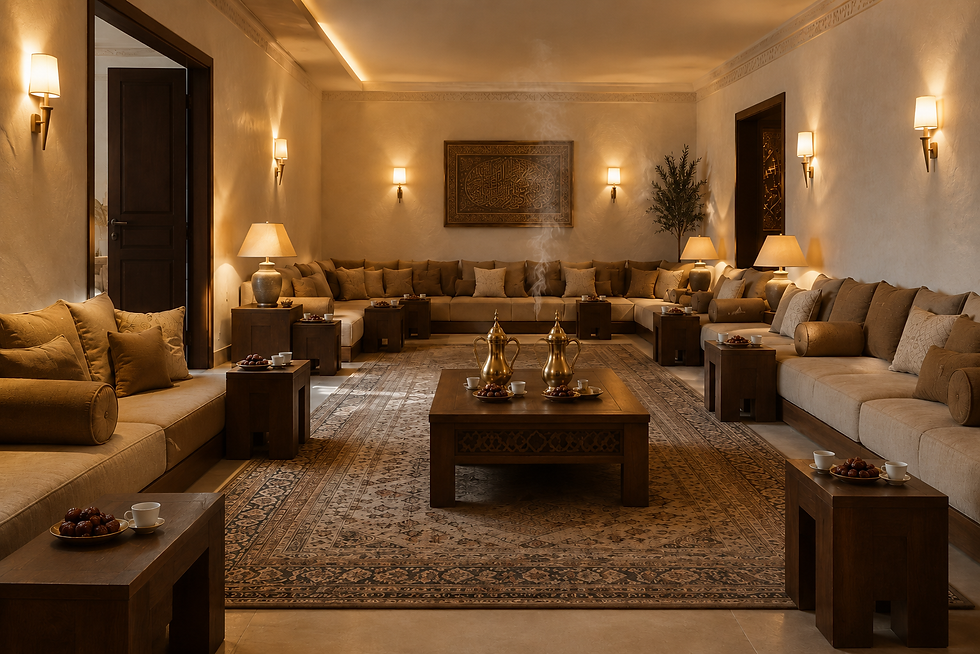
Eid Al-Adha 2026 runs May 26 to 30. Plan for three guest waves daily — after morning prayer, afternoon, evening — and a 10-minute reset between each one. Put a side table next to every majlis seat. Clear the fridge before day one so the qurbani has cold space. Refresh bakhoor twice a day, not all day. Use a dimmer to shift from bright morning to warm evening without moving a single piece of furniture.
Eid in a Saudi home is not one event. It is a five-day rhythm of arrivals, coffee rounds, meals, and overnight family. The houses that handle it well are not the most decorated ones — they are the ones set up so the host is not running.
How Do You Keep the Majlis Welcoming Across Five Days of Guests?
Three waves a day, not one big evening. The morning crowd arrives straight after Eid prayer wanting coffee, dates, and a place to sit. The afternoon group is smaller and slower. The evening wave is the longest and the warmest.
Every seated guest needs a side table within arm's reach. Without it, the Arabic coffee finjan ends up on the floor or balanced on a cushion, and the whole rhythm of the service breaks. This is the single most overlooked detail in majlis design.
Between waves, give yourself ten minutes. Fluff the cushions, empty the dates dish, refresh the bakhoor, dim the overheads a notch. That short reset is the difference between a majlis that feels fresh on day five and one that feels tired by day two.
Walk your circulation paths before guests arrive. A chair that drifted half a metre, a rug that shifted at the corner — these small bottlenecks compound over six hours of people moving in and out. For more on how the room itself should be laid out, see Contemporary Majlis Design: How to Get It Right in a Saudi Home.
What Actually Makes an Overnight Guest Feel Looked After?
A care kit on the bedside table. Nothing extravagant — a sealed toothbrush, a small soap, a comb, a tube of hand lotion. It signals you thought about the person before they arrived.
Fresh towels every day, not once at the start of the visit. Two nights on the same towel is the small thing people remember.
A working bedside lamp matters more than the chandelier. Overhead-only lighting forces a guest to choose between full glare and total dark when reading before sleep or waking for fajr.
Clear a corner for bags. A chair, a low bench, an empty patch of floor — anywhere that is not the bed. People live more comfortably out of a bag that has a place to land.
The gap between a guest room that photographs well and one that holds a person comfortably for two nights is usually these four things. For more on room-by-room priorities in Saudi homes, see Room by Room: Interior Design Priorities for Saudi Homes.
How Does the Kitchen Hold Up Across Eid Al-Adha?
Clear the fridge and freezer the day before Eid. The qurbani arrives in volume on day one — fresh, in large cuts, needing cold storage immediately. A fridge already full of leftovers cannot absorb it.
Reset the counter after every meal. A clear surface cooks faster, and a calm kitchen makes a calm host.
If the house has two kitchens — the display kitchen open to the living areas, and the secondary wet kitchen behind it — use them for their actual purposes during Eid. Plating, coffee, and light prep in the display kitchen. Heavy meat work, frying, and strong spices in the wet kitchen with extraction on and the door closed.
Distributing qurbani to relatives and neighbours happens mostly on days one and two. Designate a corner — a side counter, a section of the wet kitchen — purely for portioning and bagging. Keep it separate from where food is being prepared for the table.
How Do You Shift the Mood of Your Home Between Morning and Evening Without Moving Anything?
Two controls. Scent and light.
Bakhoor refreshed twice a day. Once before the morning guests arrive, once before the evening wave. Not in between, not continuously. A scent that never changes stops being noticed within twenty minutes — the nose adapts. The point of bakhoor is the moment someone walks in and registers it. You only get that moment if there has been a gap.
Mornings: open the curtains, turn the overheads to full, let the light be bright and clear. People have just come from prayer — they want energy, visibility, and warmth. This is not the moment for atmospheric lighting.
Evenings: dim the overheads down or off entirely. Let wall sconces and table lamps carry the room. Warm light — the 2,700K range, not the cool 4,000K white common in newer villas — does measurable work on how long people sit and stay. The Illuminating Engineering Society has decades of research showing how colour temperature shapes social behaviour. The practical result: warm dimmed light is what gets a guest to stay for a third cup of coffee at 11pm.
A single dimmer switch is the most useful tool in the house during Eid. For more on building this properly, our Lighting Guide for Saudi Homes covers fixture placement and dimming circuits.
This is not decoration. It is how the same room feels at 9am and 9pm without moving a single piece of furniture.
Key Takeaways
Plan for three guest waves daily across all five days — morning, afternoon, evening — not one big push
A side table within reach of every majlis seat is non-negotiable for Arabic coffee service
The 10-minute reset between waves (cushions, bakhoor, dim the lights) keeps the majlis fresh on day five
Empty the fridge the day before Eid so the fresh qurbani has cold space the moment it arrives
Refresh bakhoor twice a day only — before morning guests and before evening guests; continuous scent disappears
Overnight guests notice a working bedside lamp, fresh daily towels, and a small care kit more than any expensive finish
Ironwood Solutions designs homes in Riyadh that work under real hosting pressure — five-day Eids, three-wave majlis days, kitchens handling qurbani in volume. If you are planning a villa or rethinking how yours performs during the seasons that matter, contact us.


Comments