
The Best Furniture Stores in Riyadh: What to Look For and How to Choose


This guide does not list stores. Showrooms open and close, collections rotate, and a directory would be outdated before it was useful. What does not change is how to evaluate furniture — and that is what this covers.
Riyadh's furniture market has expanded considerably over the past decade. International luxury brands have opened showrooms, regional multibrand retailers carry stronger product ranges, and the market for bespoke and specification-grade pieces has grown alongside the city's residential and commercial development. For a homeowner navigating all of this, the challenge is not finding options. It is knowing how to read them.
Retail Furniture vs Specification-Grade Furniture
The difference is in how each is built, not how each looks.
Retail furniture is produced for individual sale in domestic settings — it is expected to perform reasonably over a few years of normal use. Specification-grade furniture is produced for demanding use in design projects where finish consistency, structural durability, and long-term quality are non-negotiable. The two can look identical in a showroom. They do not perform identically over time.
The difference shows up in frame construction, foam density, how the fabric is applied, metalwork tolerance, and the finish of surfaces not intended to be seen. A retail sofa's seat foam typically compresses to around 60 percent of its original density within two to three years of daily use. A specification-grade equivalent holds its profile for eight to ten. The fabric on a retail piece usually cannot withstand professional steam cleaning without dimensional change. The specification equivalent is specified to do exactly that.
When buying for a luxury home or high-specification commercial interior, ask of any piece: how was this made, and to what standard? Lift a cushion. Look under the frame. The quality of hidden construction tells you most of what you need to know.
Where to Invest and Where to Be Practical
Not every piece in a luxury interior needs to be at the top of the specification range. The practical approach is to identify the pieces that carry the most visual and tactile weight in the space and concentrate the investment there.
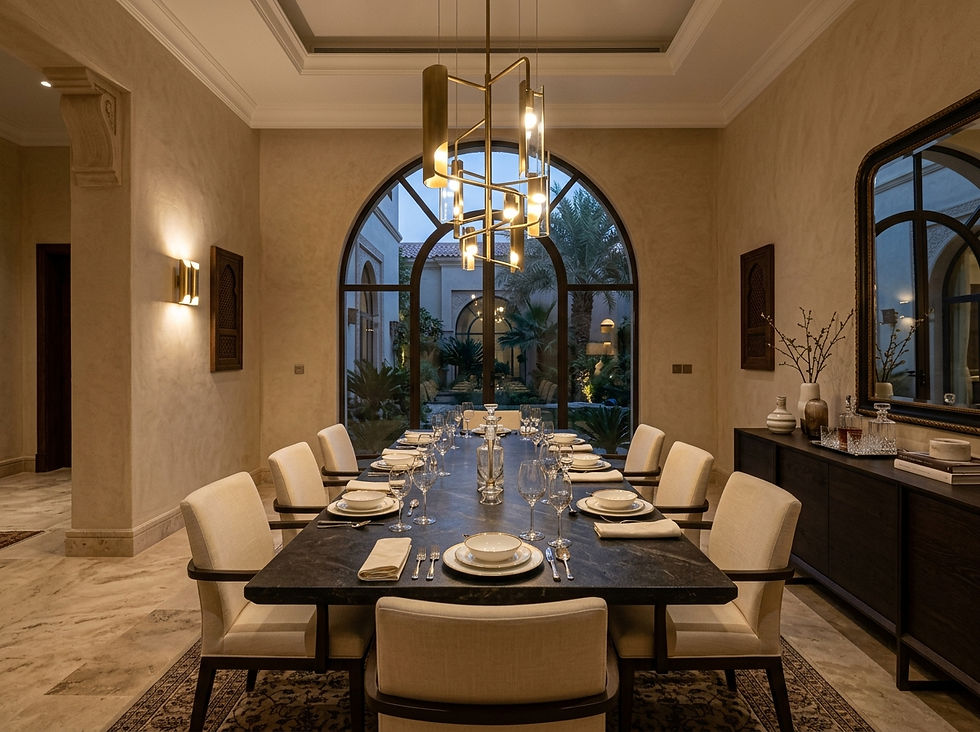
Primary seating — sofas, armchairs, dining chairs — is almost always worth the premium. These are the pieces that define a room's character, that guests touch directly, and that reveal the quality of a space within the first thirty seconds of entering it. A well-specified sofa in a carefully chosen fabric holds its shape and anchors the room for years. Its retail equivalent tends to date, sag, and pull the quality of everything around it down with it.
Dining tables and coffee tables in natural stone or solid timber are similar. These pieces do not date. Their surfaces improve with use. A travertine table top in a room ages into a patina that a manufactured alternative simply cannot produce. Riyadh's stone table market has deepened considerably — travertine, marble, honed limestone are available at a range of specification levels — but the gap between a surface that has been properly filled, sealed, and mounted and one that has not is visible within two years.
Storage and case pieces — wardrobes, sideboards, bookshelves — are usually candidates for bespoke production rather than retail purchase in a luxury interior. A joinery piece built to the dimensions of the room, in materials consistent with the broader design, will outperform a retail equivalent in both function and longevity. The cost gap between a well-specified retail piece and a bespoke equivalent is narrower than most clients expect — particularly for pieces that will stay in the space for a decade or longer.
What the Riyadh Market Does Well
Riyadh has strong representation of European and American luxury furniture brands through mono-brand showrooms and multibrand retailers. Italian brands in particular — known for precision metalwork, leather quality, and material specification — are well represented. For statement pieces, being able to see and touch the actual product before ordering is a meaningful advantage over international online purchasing.
The local bespoke joinery market has also matured. There are Riyadh-based workshops now capable of producing cabinetry and case pieces to a specification standard that competes with imported equivalents — with the additional advantage of shorter lead times, greater dimensional flexibility, and the ability to match materials to the specific conditions of the Saudi climate.
The Most Common Mistake
It is not overspending. It is buying individual pieces without a coherent material logic governing their selection.
A room furnished from several different high-quality sources — without a unifying consideration of proportion, material tone, and visual weight — will feel inconsistent regardless of the individual quality of each piece. The sofa from one showroom, the dining table from another, the lighting from a third: each may be excellent. Together, without a framework governing how they relate, they produce a room that feels assembled rather than designed.
Furniture selection works best when it happens within a design brief — when proportions are calibrated to the room's dimensions, when the material palette is managed across all pieces simultaneously, and when the relationship between fixed elements (floor, ceiling, wall) and moveable ones (furniture, lighting, objects) is treated as a single decision rather than many separate ones.
Ironwood Solutions and Furniture Specification
At Ironwood Solutions — a Riyadh-based luxury design firm operating since 2016 — furniture selection is fully integrated into the design process, not treated as a separate retail exercise. The firm sources from international luxury suppliers, commissions bespoke pieces from trusted local and regional workshops, and manages procurement, delivery, and installation as part of the broader project.
For clients in Riyadh planning a residential or commercial interior, the consultation is where that process begins.
Frequently Asked Questions
What is the difference between retail and specification-grade furniture?
Specification-grade furniture is built for demanding use in design projects — higher frame density, structural foam that holds its profile for eight to ten years, and fabrics specified to withstand professional cleaning. Retail furniture is built for domestic sale and typically performs for two to five years before visible deterioration.
Is bespoke furniture in Riyadh more expensive than buying imported pieces?
Not necessarily. For storage and case pieces — wardrobes, sideboards, bookshelves — the cost of a well-specified bespoke joinery piece built locally is often comparable to importing an equivalent. The advantage is dimensional precision, shorter lead time, and the ability to match materials to the room exactly.
Which furniture categories are worth the highest investment in a luxury interior?
Primary seating (sofas, armchairs, dining chairs) and natural stone or solid timber tables. These carry the most visual and tactile weight in a space, and the performance gap between retail and specification grade is most visible here over time.

Comments