
Najdi Interior Design: Saudi Arabia's Architectural Heritage


Najdi architecture — the built heritage of the central Arabian plateau — developed not as an aesthetic choice but as a direct response to specific conditions: extreme summer heat, scarce resources, the cultural requirements of hospitality and privacy, and an aesthetic sensibility that found beauty in precision, proportion, and the patient elaboration of geometric form. The mud-brick towers of Diriyah, the carved wooden mashrabiya screens of traditional Riyadh homes, the geometric plasterwork of historic mosques — these are not decoration. They are solutions.
For decades, rapid urbanisation and the easy availability of international building materials pushed this heritage into the background of new Saudi construction. Vision 2030's investment in cultural identity — visible most concretely in the rehabilitation of Diriyah as a living cultural district — has produced a renewal of interest in Najdi design as a working language. For homeowners and designers in Riyadh today, the question is not whether to engage with this heritage but how to do so with the authenticity it deserves rather than the pastiche it too often receives.
The Four Defining Characteristics
Earthen Materiality
Traditional Najdi construction uses the materials of the earth: mud brick, local sandstone, date palm timber, and gypsum plaster. This palette produces warmth and textural depth that concrete, glass, and imported stone consistently fail to replicate — not because they are lesser materials but because they are foreign to this landscape.
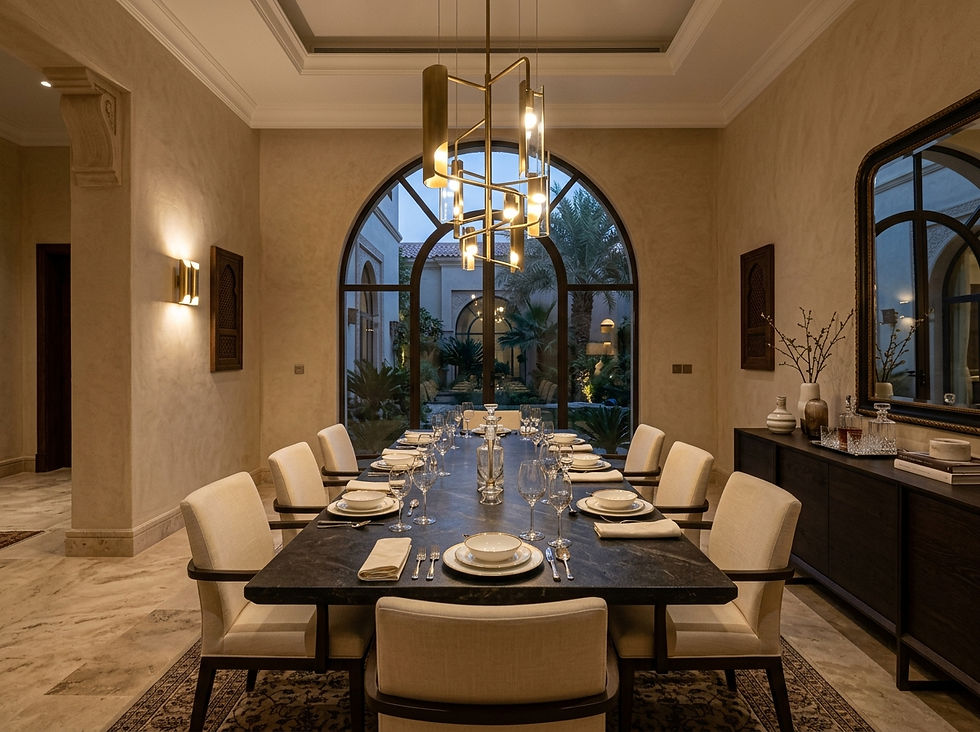
In a contemporary interior, translating this principle means: hand-applied plaster walls in warm off-white or ochre, sandstone or travertine floors in honey tones, timber elements in species with visible grain. Not a reproduction of traditional construction. A translation of its material logic into the vocabulary of a contemporary space.
Geometric Precision
The geometric vocabulary of Najdi design — in plasterwork, carved timber, ceramic tile, and handwoven textile — is among the most technically sophisticated decorative systems in the Islamic tradition. The patterns are not ornament applied to structure. They are the structure made visible: each derived from precise geometric construction, expressing in form the mathematical principles that govern the built environment.
In a contemporary interior, this vocabulary appears in plaster ceiling relief, in mashrabiya screens that filter light while maintaining privacy, in carved timber door surrounds, and in the handwoven textiles that carry geometric pattern as a structural rather than decorative element.
Climate-Responsive Spatial Logic
Najdi architecture developed specific responses to extreme heat long before mechanical cooling existed. Courtyard plans shade outdoor space for most of the day. Walls at 50–80 cm thick store cool night air and release it slowly through the afternoon. Small high windows admit light while blocking direct sun. The mashrabiya screen creates cross-ventilation while preventing solar gain.
Many of these strategies translate directly into the contemporary Saudi interior — not as features to be copied but as spatial principles that are still climatically intelligent. Orienting the plan to limit west-facing glazing, using thermal mass in floor materials, positioning natural light sources to illuminate without overheating — all of these are Najdi principles applied to a contemporary brief.
The Hierarchy of Hospitality
Najdi spatial organisation reflects the cultural priority of hospitality in the Najd. The public receiving areas — the majlis, the entrance sequence — receive the highest investment of craft and material quality. Not the bedrooms. Not the service areas. The spaces that receive guests.
This is not sentimental tradition. It is a spatial logic with direct consequences for how a contemporary Saudi villa allocates its design budget. A well-designed villa whose guest reception spaces are executed at a significantly higher specification than the private family areas is applying a Najdi principle to a contemporary brief — and producing a space that communicates the right things to the right people.
Engaging Heritage Without Producing Pastiche
The risk is copying motifs rather than applying principles. A contemporary interior with geometric stenciling on the walls and a mashrabiya screen in the entrance is not a Najdi interior — it is a contemporary interior wearing traditional costume.
The distinction that matters is whether heritage is working as structure or as decoration. A well-designed contemporary Najdi-influenced interior may not contain a single object that reads as "traditional." What it will have is: earthen warmth in its material palette, geometric resolution in its architectural details, spatial generosity in its reception zones, and a quality of groundedness that no imported style produces. Heritage as logic, not as surface.
Ironwood Solutions and Najdi Design Identity
At Ironwood Solutions — a Riyadh luxury interior design firm founded in 2016 — Najdi heritage is not a stylistic category. It is embedded in how the firm approaches every Saudi residential project: asking how the spatial logic, material palette, and geometric vocabulary of the Najd can be engaged authentically in a contemporary context, producing homes that are world-class in their execution and unmistakably Saudi in their character.
For homeowners in Riyadh who want a home that is genuinely from here rather than borrowed from elsewhere, the consultation is where that conversation begins.
Frequently Asked Questions
What makes Najdi design different from other Islamic design traditions? Najdi design is specifically shaped by the central Arabian environment — its material palette reflects local geology (sandstone, gypsum, date palm), its spatial logic responds to the extreme heat of the Nejd plateau, and its geometric vocabulary developed within the specific cultural traditions of central Arabia. It is distinct from Hijazi, Andalusian, or Persian Islamic design traditions, each of which developed in response to different climates and cultural contexts.
How do you apply Najdi design principles without producing pastiche? Work at the level of principle, not motif. Earthen warmth in the material palette, geometric resolution in architectural details, spatial generosity in reception zones — these are principles. Applying geometric stencils to walls or adding a mashrabiya screen as decoration is costume. The test is whether the heritage is functioning as structure or applied as surface.
Is Najdi-influenced design appropriate for a contemporary luxury interior? Yes. The principles of Najdi design — material warmth, geometric precision, climate-responsive spatial logic — are entirely compatible with contemporary luxury execution. The most successful Saudi interiors working in this vein produce spaces that are both world-class in their specification and unmistakably rooted in central Arabian culture. These are not mutually exclusive qualities.

Comments