
Scent Design in Luxury Interiors: The Most Memorable Sense

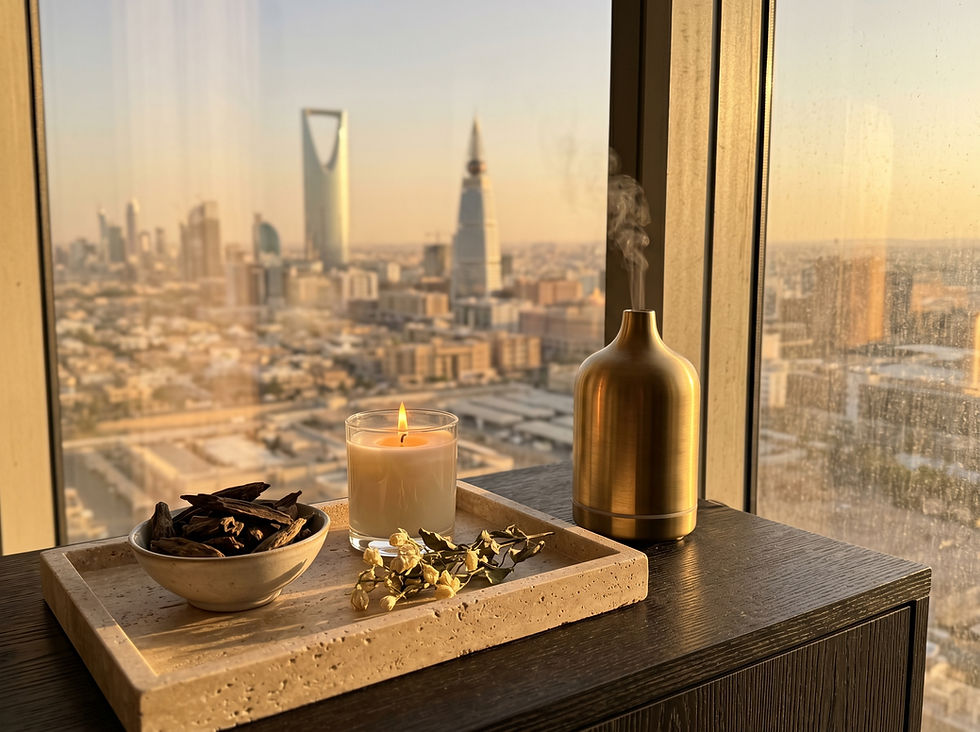
You can photograph a space. You can record its acoustic character. You can describe the weight of its materials and the temperature of its light. You cannot photograph a scent — but of all the sensory dimensions of a built environment, scent is the one people remember longest, recall most viscerally, and return to most involuntarily.
This is not sentiment. It is neuroscience. The olfactory system is the only sensory channel that bypasses the thalamus — the brain's relay station — and connects directly to the limbic system, the seat of emotional memory. A scent experienced in a specific space encodes that space into long-term memory in a way that visual, acoustic, or tactile experience does not replicate.
For luxury interior designers, this creates both an opportunity and an obligation. Scent is the most emotionally durable sensory dimension available — and in most luxury projects, it is left entirely to chance.
What Olfactory Design Actually Means
Olfactory design is the deliberate management of how a space smells — not through the addition of fragrance over an existing olfactory environment, but through the considered specification of materials, finishes, plants, and air quality from the earliest stages of the brief.
Most discussions of scent in interiors leap immediately to fragrance diffusion: the plug-in diffusers, the scented candles, the HVAC-integrated fragrance systems used by luxury hotels. These are valid tools, but they represent the end of an olfactory design process, not the beginning of one. Used without a prior understanding of the space's existing olfactory character — the smell of its materials, its ventilation behavior, its ambient baseline — they mask rather than design.
A space that smells of expensive diffused fragrance but whose underlying material palette carries the smell of synthetic finishes, adhesives, or mechanical air conditioning is not an olfactorily designed space. It is a covered one. The difference registers subconsciously in every person who enters — a slight mismatch between the deliberate and the ambient, a sense that something has been applied rather than resolved.
True olfactory design begins at the material level and moves outward. It asks: what does this space smell like without any fragrance intervention? And is that smell consistent with the emotional register the space is intended to produce?
The Olfactory Properties of Luxury Materials
Every material in a built environment has an olfactory signature — most of them subtle, some of them significant. Understanding these signatures is the foundation of olfactory design.
Natural Stone
Travertine, marble, and limestone are among the most olfactorily neutral materials available to an interior designer. They carry almost no scent of their own, which makes them an ideal base for an olfactory composition — a neutral ground against which other scent elements can register clearly. Polished stone sealed with synthetic products, however, introduces a faint chemical note that undermines this neutrality. The specification of natural, low-VOC sealants is not only a health consideration — it is an olfactory one.
Timber
Timber is olfactorily generous. Different species carry distinct scent profiles: cedar is warm and slightly spiced; walnut is rich and earthy; oak is clean and faintly sweet. In a luxury interior, the specification of solid timber — rather than engineered alternatives or laminates — introduces a natural olfactory depth that no diffused fragrance can replicate. The scent of real wood in a space registers as material authenticity, in the same way that the weight of dense stone registers as quality under the hand.
In Saudi Arabia's climate, where interiors are heavily air-conditioned and the transition from outdoor heat to indoor coolness is abrupt, timber surfaces warm slowly and release their scent more gently than in humid environments. This makes the choice of species — and the finishing treatment applied — particularly consequential for the olfactory character of the space.
Textiles
Natural textiles — wool, linen, cotton, leather — each carry a faint but distinct olfactory character. Wool has a warmth that reads almost like skin. Linen is clean and dry. Leather, particularly in its natural untreated form, adds a richness that is closely associated with quality in hospitality and automotive contexts. Synthetic alternatives — polyester, acrylic, vinyl — have no natural scent of their own, but off-gas volatile organic compounds over time, producing an ambient chemical note that registers as generic and unresolved.
In a luxury residential or commercial specification, the preference for natural textiles is justified on multiple grounds: tactile, visual, acoustic, and — often overlooked — olfactory.
Plants and Botanicals
Living plants introduce a biological scent dimension that no material or diffused fragrance can replicate. Jasmine, in particular, is deeply embedded in the olfactory memory of the Gulf region — its scent carries cultural associations that make it an exceptionally powerful tool in a Saudi residential or hospitality context. Dried botanicals — oud wood, rose petals, dried herbs — provide a more stable, low-maintenance olfactory element that complements rather than competes with the space's material palette.
The integration of plants and botanicals into a luxury interior is not an interior styling decision. It is an olfactory specification decision — one that should be made against the sensory brief rather than selected from a plant catalogue at the final staging stage.
Signature Scent: The Commercial Dimension
In commercial luxury environments — hospitality, retail, professional services — scent performs a function that goes beyond ambiance. A signature scent, consistently present across all client touchpoints, encodes the brand into olfactory memory in a way that no visual or verbal communication can achieve.
The research on this is substantial. Studies in retail environments consistently show that ambient scent increases dwell time, elevates perceived product quality, and strengthens brand recall. In hospitality, guests who associate a specific scent with a property are significantly more likely to return — not because they consciously remember the scent, but because encountering it triggers the emotional memory of the previous experience.
For luxury brands in Riyadh operating in a highly competitive hospitality and retail market, a signature scent is not a cosmetic addition. It is a retention and differentiation instrument — one of the few brand elements that operates below conscious attention and therefore below the threshold of competitive imitation.
Developing a signature scent for a commercial space is not a matter of choosing a preferred fragrance. It requires an understanding of the brand's emotional positioning, the cultural context of the audience, and the olfactory baseline of the physical space into which the scent will be introduced. In Saudi Arabia specifically, where oud, rose, and amber carry deeply embedded cultural significance, the selection of scent notes is both a design decision and a cultural one.
Scent and the Saudi Context
Few markets in the world have as sophisticated a relationship with scent as Saudi Arabia. Oud burning, the use of bakhoor, and the gifting of layered fragrances are deeply embedded in Saudi social ritual — scent is not a background element in Saudi culture, it is a foreground one. It is used to welcome guests, to mark occasions, and to communicate hospitality and generosity.
This cultural sophistication creates both an elevated expectation and an elevated opportunity for olfactory design in the Saudi market. Saudi clients do not need to be educated on the significance of scent — they already understand it intuitively. What they recognize immediately, and respond to viscerally, is the difference between a space whose scent has been considered and one whose scent is an afterthought.
For Ironwood Solutions' residential and commercial clients, this means that olfactory design is not a refinement introduced for international sensibility. It is a locally resonant design dimension that speaks directly to the cultural intelligence of the Saudi client — and, when done well, produces a space that feels unmistakably considered in a way that is immediately recognizable to the people who know scent best.
Common Mistakes in Luxury Scent Specification
There are three recurring errors in how scent is addressed in luxury interior projects.
The first is treating scent as a styling element — something added at the end of the project, like cushions or artwork, to make the space feel finished. Scent cannot be added to a space in the same way a decorative object can. It is embedded in the material palette from day one. The decision to specify synthetic finishes rather than natural ones, or engineered timber rather than solid, is already an olfactory decision — even if it is not made with olfactory awareness.
The second is fragrance masking. Using a diffused scent to cover an unresolved olfactory baseline — mechanical air, synthetic materials, cleaning products — produces a confused olfactory environment that registers as inauthentic even when the specific problem cannot be named. Guests and clients sense the conflict between the deliberate fragrance and the ambient baseline, and the result undermines rather than enhances the impression of quality.
The third is cultural mismatch. Selecting a scent profile that is tonally inconsistent with the cultural context of the audience — introducing fresh aquatic or green notes into a space designed for a Saudi clientele that associates luxury with warmth, depth, and richness — produces an olfactory environment that feels foreign rather than refined. In the Saudi market, the most effective luxury scent profiles draw on the warm, resinous, and floral notes that carry the deepest cultural resonance: oud, amber, rose, sandalwood, and their combinations.
The Ironwood Approach to Olfactory Design
At Ironwood Solutions, olfactory design is addressed in the sensory brief alongside texture, light, and acoustic strategy. The brief defines the intended olfactory register of each zone: the material baseline the space should achieve through its specifications, the role of plants and botanicals in the olfactory composition, and — for commercial clients — the parameters of a signature scent aligned with the brand's positioning and its audience's cultural context.
Material specifications are evaluated for their olfactory contribution. Natural materials are preferred not only for their tactile and visual qualities but for the authentic olfactory depth they introduce. Synthetic finishes that would compromise the olfactory baseline are identified and replaced at the specification stage — not corrected with fragrance after the fact.
For clients requiring a signature scent, we work with specialist fragrance consultants to develop a scent profile derived from the brand intelligence brief — ensuring that the olfactory identity of the space is as strategically grounded as its visual and spatial identity.
The result is a space where scent is not something you notice on arrival and forget within minutes. It is something you carry with you — a sensory memory that makes the space impossible to forget, and difficult to replicate.
Evaluating the Olfactory Quality of Your Space
If you are assessing whether an existing space has an unaddressed olfactory dimension, these questions are a reliable starting point:
What does this space smell like when it has been unoccupied and unventilated for several hours — and is that smell consistent with the quality the space is designed to communicate?
Is there a persistent mechanical or chemical note — from air conditioning, synthetic finishes, or cleaning products — that cannot be fully covered by fragrance?
Does the space have any deliberate olfactory element — natural materials, botanicals, a signature scent — or is its olfactory character entirely ambient and unmanaged?
For commercial spaces: do clients or guests ever comment on how the space smells — positively or negatively?
Is the scent profile of this space consistent with the cultural expectations of its primary audience?
If any of these produce hesitation, the olfactory layer of the space is either absent or unresolved. In many cases, targeted interventions — the introduction of natural material elements, the replacement of synthetic finishes with natural alternatives, or the development of a simple scent program anchored to the space's existing character — can significantly elevate the olfactory quality without a full redesign.
Beginning the Conversation
Scent is the sense that outlasts the visit. Long after a client has left a space, after the visual impression has faded and the conversation has been forgotten, the olfactory memory remains — triggered without warning by an encounter with a similar note months or years later. That durability is what makes olfactory design one of the highest-leverage investments available in a luxury environment.
Ironwood Solutions includes olfactory strategy as a core component of every sensory brief — residential and commercial. If you are planning a new project, or evaluating an existing space whose olfactory character does not match its visual ambition, the conversation begins here.


Comments